Teachers participate in National Board Certification
January 13, 2011 by maxwellk
Filed under News, Top Stories
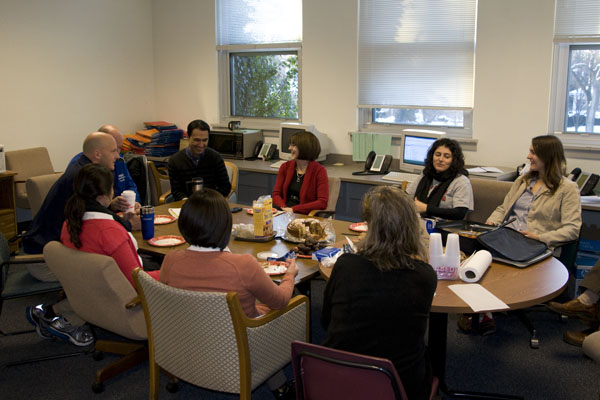
In the spring of RB’s 2008-2009 school year English teacher Kirstin Bacon gave a speech about a program called National Board Certification. The program is an intensive process that helps teachers develop professionally and rewards them with a certificate that lasts for ten years. She invited the teachers in attendance to apply and five teachers answered the call. Those teachers include: Dan O’Rourke, Julie Obradovic, Jessica Mauritzen, Laurence Forberg, and Jill McGrath.
“The process was very intense. I did not know what to expect when I started, but I learned quickly that it was a very involved program. Particularly the last few months, that was the focus if all of my free time,” said Obradovic.
The teachers entered a very rigorous program that required them to do many things. First, they needed to have a bachelor’s degree, have taught for at least three years, and possess a valid state license. Then, they had to collect data and defend it in four, sixteen page journals that went through at least ten revisions each. The journals’ content varied from teacher to teacher depending on their field. Lastly, each applicant needed to take a six part exam that tested their abilities. On top of all of that, teachers trying to earn this certification must accomplish it within three years.
McGrath pointed out that, “less than .4% of teaching population tries to do this.”
The RB teachers that applied for the certification found out whether they passed in November of this year. Out of the five teachers who attempted it, Forberg and O’Rourke were the only ones that passed. The other three were very close, but they didn’t quite make it. Luckily when those teachers reapply, their previous scores will be banked and they will only need to tweak certain parts of the process. Also, they feel more confident this time because they know what to expect.
“This was the best professional development I’ve ever done. It made me grow the most,” said McGrath.
Whether they passed or not, each teacher that tried to achieve the certification had a fulfilling experience. Each one learned how to be a better teacher by analyzing themselves, talking with each other about their methods, and by applying feedback from the journals to the classroom. The applicants said they would recommend this program to other teachers, and even said that they would be a mentor in the future.
Rooftop garden: one step closer to a green school
English teacher Kathleen Harsy is the main advocate for a rooftop garden atop our very own RBHS. A rooftop garden is just what it seems to be: a garden on top of a building, used to grow vegetables and herbs, reduce energy costs, and just overall make greener choices.
Although Harsy is head of this project, there are many other people involved. Tim Scanlon, Kirstin Bacon, Tom Dignan, John Izaguirre, and the SEE team students and teachers Jame Holt, Jennifer Waldock, and Dan Mancoff are all involved in the garden, and will be reaching out for more support.
The purpose of a rooftop garden at RB is basically to have an interactive green space. Students can actually do something instead of just sitting and learning in a textbook. It expands on the fact that the green movement isn’t just a fad, but it is how the world really works now. The garden also creates interdisciplinary opportunities within the school, meaning that English could coincide with the science department in projects concerning the garden.
Harsy said “[The garden would] foster a new generation of environmental stewards.” There are connections to the Character Counts program with the garden, as well has being able to make direct lesson plans to reflect upon it.
“Kids get so excited about it. They think going up to the roof is so cool,” said Harsy.
A rooftop garden could reduce energy costs and allow students and staff to interact with a living ecosystem. Not only that, but students and staff could actually consume the vegetables and herbs that will be grown in the garden, which could improve the food choices in the cafeteria.
Part of the funding for the garden is coming from last year’s senior gift, which is when the idea really got kicked off. It is not funded by the school, so Harsy and others are in the process of getting outside grants to fund the rest of the garden, which will be about $5000.
The restaurant Uncommon Ground has a rooftop garden, and Harsy has been in contact with them about RB’s plans for one.
Safety is not an issue because the school already has easy and safe access to the roof.
“Administration is really open to this idea. It really speaks to how committed they are to the best practices for teachers and students,” said Harsy.
Huge jump in scores means RB passes AYP
RB was shocked last year when it was revealed that for the first time ever, the school failed to meet AYP standards.
During the 2008-09 school year, former superintendent/principal Jack Baldermann said he was “certain that the scores would improve in the following year.” Baldermann’s enthusiasm was confirmed this year when RB once again succeeded in making AYP.
The No Child left Behind Act of 2001 activated national AYP (Annual Yearly Progress) standards. The aim of AYP is to set an amount of students that are required to meet or exceed standards on standardized reading and math tests each year. The standards are raised each year in order to set students on the right track, ultimately ending with the 2013-14 school year where 100% of juniors are expected to meet or exceed the standards.
When there are 45 or more students of a certain group in a given grade, they are tested as a subgroup, these subgroups are grouped based on ethnicities, free or reduced lunch, and other various factors. In the 2007-08 school year, Illinois schools students were expected to reach 62.5% proficiency on the tests. Only 40.4% of the Hispanic subgroup at RB passed the reading portion of the PSAE (Prairie State Achievement Exam), causing RB to fail AYP for the first time.
Baldermann instituted numerous programs to help raise scores, and ultimately put RB back on track. Several programs and workshops were made available for all students at RB to help with reading, math, writing, and science portions of the PSAE, and ACT. CAP classes were taken advantage of by a majority of students, as well as after school courses, morning courses, and Saturday courses. These classes were only a small fraction of the price that they would normally be if taken privately.
The efforts taken by administration last year proved successful with remarkable results this year, actually being the best test results since 2003. 75.6% of juniors passed the reading portion of the PSAE, a 5.1% increase from 08-09. The Hispanic subgroups scores alone jumped from 40.1%, to a staggering 74.5%. In addition to reading and math scores, AYP also relies on ACT composite scores, and graduation rate. The average ACT score last year was 23.5, with the state average in 2008 being 20.5. The minimum requirement of graduation rate in Illinois was 78% last year, however, RB once again soared far past the requirement, with a graduation rate of 97.6%. Where many schools fail to make AYP, RB passes with flying colors. Graduation rate is a place where many schools struggle.
Assistant Principal Troy Gobble said it was truly a “wonderful Feeling”. Last year, Gobble and other important administration figures met every Thursday for an hour at the least to discuss what they were currently doing, and could do in the future to help students perform better on standardized tests. These meetings included Jack Baldermann, Doug Shultz (Math specialist), Troy Gobble, Tim Scanlon, George Miller (English specialist), and Laurie Ritchey(PSAE Coordinator).
Not just the English scores increased this year, Math scores significantly increased as well. Gobble noted that as well as English, “the Math was all part of it” and that it “lives in the CAP program”.
The Image Test was a special test meant for ESL students, and new speakers of English. It included a test mirroring the PSAE, but with a more accessible vocabulary for these students. The Image Test was discontinued in before the 2008 testing and may have contributed to the low reading score of the Hispanic sub group in 2008. Gobble stated “it surprised us last year. This year we knew it was coming and we prepared the students for it.”
And the progress continues at RB. 200 juniors out of a class of 350 are enrolled in CAP, and the ACT help sessions are still planned to commence later in the year.
Even some new programs are going into effect this year. The brand new Reading Infusion Program has already been used to increment the reading abilities of RB students.
Reading Infusion is a new program that habituates the use of reading skills in classes that don’t necessarily revolve around reading, but include it. The program forces students to better their reading skills to succeed in numerous classes. Reading Specialists Sarah Johnson and Kirstin Bacon teach other teachers around RB how to help their students become better readers by infusing reading abilities into their lesson plans. Some of the classes Reading Fusion has been used in include some Western Civilization classes, Biology classes, and English classes.
Gobble explained that “by starting at Freshman year, the students will become better readers in the future.”
Another contribution to the raise in scores last year was the involvement of the community. OLAS (organization of Latin American Students) also played a part. Baldermann attended an OLAS meeting to encourage the students to take advantage of the resources given by the school. }
Gobble said, “OLAS allows a lot of students to be more of a part of the school.”
OLAS president Rafael Romero said, “Hispanic students were offered optional sessions during lunch where they would practice for standardized tests.”
“We called Hispanic students and their families in and explained the importance of the test,” Said Gobble. “We want them to go to college, and we wanted the parents to be part of the RB community.” Gobble also said “We were lucky to have such a talented Hispanic group, and it really speaks a lot about the community”.
The No Child left Behind Act requires 100% of students to pass the tests in 2014 in order to make AYP. Gobble explained RB’s plans for the future which include a continuation of the programs, and the meetings. “I like big goals, but 100% of students passing is unrealistic,” Said Gobble. Gobble believes that at some point in the future RB will fail AYP again, but the administration is going to do everything in their power to make sure that the students pass as long as possible. RB is already doing far better than many schools across the state and the country. Most schools in Illinois already don’t make AYP; Last year was still RB’s first and only year to not pass AYP, and RB proved to make it a single year tradition.
Since Baldermann’s resignation, individuals he was in charge of have continued his efforts to raise test scores. “He deserves credit,” said Gobble. The Thursday meetings between administration members continue to take place into the 2009-10 school year, and RB continues to practice programs both old and new to help the cause.