Students, staff adjust to new tardy policy

March 18, 2010 by dmancoff  
Filed under Local News, News, Top Stories

Tell us what YOU think about discipline at RB. Take our survey!

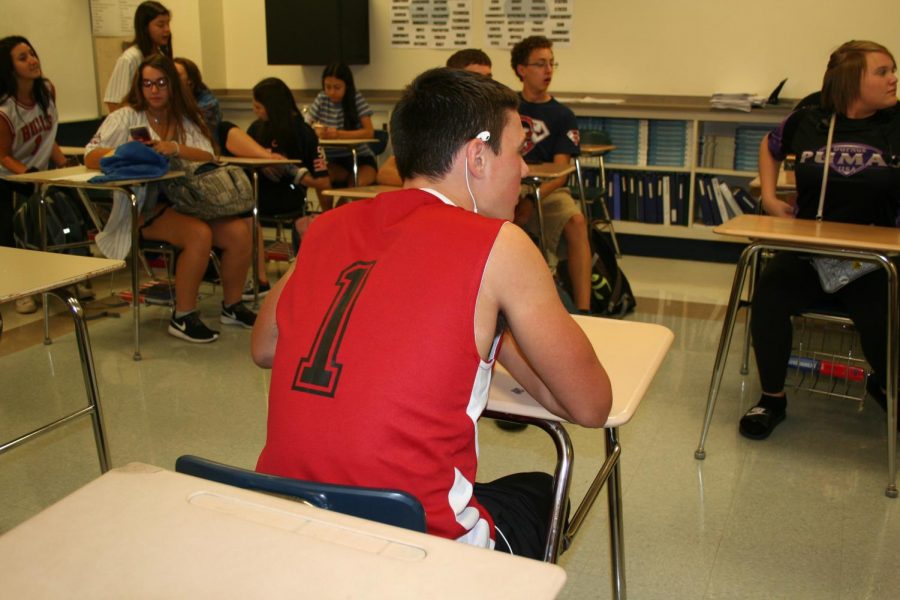
RB has been operating under a revised tardy policy since the beginning of the second semester. The policy has become the talk of the students, as well as the staff at RB. The policy was reconfigured by Interim Assistant Principal Troy Gobble, Interim Principal Tim Scanlon, Assistant Principal John Passarella, and Dean David Sibley after many teachers showed concern with the issue.

The tardy policy is not entirely new. According to Sbley, “it’s the old policy, with some tweaks.” One of those tweaks is a renewed emphasis on consistent enforcement of the policy by staff and teachers. Teachers are also now required to call a student’s parent or guardian if they have received three tardies. A guideline has been established for the new punishments, including a Saturday detention after the fourth tardy, and an ADA (alternative daily assignment) after the sixth.

Another change to the policy is that tardies are being responded to more quickly than before. Students are now likely to be called down to the office the same day they receive a number of tardies.

To explain the reason for the changes, Gobble said, “What we found was that the policy had become difficult to enforce consistently, and for good reasons. Students and teachers were adjusting to a new building and nobody knew where they were going, and also teachers were just getting used to using Skyward. As a result, tardies became more frequent than they were in the past. Students were coming late to class because the policy felt undefined.  Now that it has been tightened up, the number of tardies has dropped significantly.”

Sibley agreed and said, “it’s getting better. Once kids started realizing they were getting ADA’s for tardies, they were more motivated to get to class on time. The teachers are doing a great job enforcing [the policy], and are really making a difference.” Sibley feels that the vast majority of the teachers are cooperating with the new policy.

Gobble noted that the biggest problem had been first period. He said, “[There were] as many tardies to that period alone as the amount of tardies to any period for the remainder of the day. My first thought was maybe the students were just having trouble getting to school, but we found that was not the problem. We got a map of the school district, and plotted on the map the homes of the students late to first period, and found that there were just as many tardy students from the Hollywood area as there were Broadview and North Riverside.”

Gobble also said there was a day where staff members were posted at each door of the school to count the number of students coming in after the bell rang. They ended up counting 20 students that arrived to school late, but received 50 students tardy to first period that day, leading them to believe the other 30 students were in the building on time but still arriving late to class.

“I think it’s just the high school culture that the morning is the time for students to socialize with their friends,” said Gobble.

Social science teacher John Fields served on this year’s discipline committee. Fields, as well as a number of teachers from RB on the committee, were given the task of compiling a survey for the rest of the teachers about discipline at RB.

“[The survey] gauged how teachers felt about certain issues” said Fields.
Several of the questions on the ten question survey asked about tardiness and attendance.

“I have not yet analyzed the results,” said Fields, “but I think it’s always good to evaluate how things are going.”

The new attention to attendance and tardies has resulted in other changes. Attendance is now posted live on Skyward, so parents can check to see if their student is in class at any point during the school day.

Spanish teacher Jenna Passananti said, “[The new policy] has helped tremendously. In my classes [tardiness] has improved, and the kids are seeing it as more of a priority to get to class on time and are realizing that those two to three minutes in the beginning of class are still part of class. This policy allows the teachers to find their own tardy policy with in their classroom, and if it gets out of control, we have a uniform school policy to fall back on. It really bothered me when students didn’t get to class on time. Any improvement helps.”

Social Studies teacher Dan Monahan has his own views on the policy. He said, “Until there are no tardies, it’s not harsh enough. In my classes personally, I’ve noticed a slight improvement. We’ll analyze the data at the end and see if it has improved.” Monahan said he noticed “no change in behavior from the students,” and still notices kids in the halls after the bell rings.

Monahan also said, “My personal belief is that the punishment doesn’t need to be more or less, but that it needs to be different. I don’t feel that students care about getting detentions, or that they change the student’s behavior at all. If it’s not uncomfortable enough to get the students to stop, then it should be changed.” He suggested that the school should seek alternate consequences for tardies, such as revoking parking permits, or participation in Sixth Man and other school events.

English teacher Sarah Johnson said, “If we aren’t all on board it doesn’t work. Any policy is only as strong as the people adhering to it.”

Many of the students at RB don’t feel as optimistic about the policy, noting flaws with the policy’s structure.

Junior Kylin Collier said, “It’s too ridiculous because the school can’t expect a student to be on time to every class if they have seven classes every day. When they keep handing out detentions it just frustrates the students and takes away from the learning. There are still people tardy every single day.”

Junior Watoris Slater said, “If you’re one minute late, then you may as well just skip the class because you’re going to get a detention anyway.”

Junior Brendan Mortimer said, “It doesn’t work because it doesn’t get enforced right. The teachers play favorites, kids that the teachers like never get marked tardy, but the kids they don’t like always get marked tardy.”

Sibley noted how punishments were decided. “We just follow the handbook, and there are certain things we are mandated by the state to do. The state requires us to follow the guidelines set forth by the Board of Education. Don’t be tardy and you won’t have to see me,” he said.

Huge jump in scores means RB passes AYP

October 13, 2009 by wilsonbri  
Filed under Local News, News

RB was shocked last year when it was revealed that for the first time ever, the school failed to meet AYP standards.

During the 2008-09 school year, former superintendent/principal Jack Baldermann said he was “certain that the scores would improve in the following year.”   Baldermann’s enthusiasm was confirmed this year when RB once again succeeded in making AYP.

The No Child left Behind Act of 2001 activated national AYP (Annual Yearly Progress) standards. The aim of AYP is to set an amount of students that are required to meet or exceed standards on standardized reading and math tests each year. The standards are raised each year in order to set students on the right track, ultimately ending with the 2013-14 school year where 100% of juniors are expected to meet or exceed the standards.

When there are 45 or more students of a certain group in a given grade, they are tested as a subgroup, these subgroups are grouped based on ethnicities, free or reduced lunch, and other various factors. In the 2007-08 school year, Illinois schools students were expected to reach 62.5% proficiency on the tests. Only 40.4% of the Hispanic subgroup at RB passed the reading portion of the PSAE (Prairie State Achievement Exam), causing RB to fail AYP for the first time.

Baldermann instituted numerous programs to help raise scores, and ultimately put RB back on track. Several programs and workshops were made available for all students at RB to help with reading, math, writing, and science portions of the PSAE, and ACT. CAP classes were taken advantage of by a majority of students, as well as after school courses, morning courses, and Saturday courses. These classes were only a small fraction of the price that they would normally be if taken privately.

The efforts taken by administration last year proved successful with remarkable results this year, actually being the best test results since 2003. 75.6% of juniors passed the reading portion of the PSAE, a 5.1% increase from 08-09. The Hispanic subgroups scores alone jumped from 40.1%, to a staggering 74.5%.  In addition to reading and math scores, AYP also relies on ACT composite scores, and graduation rate. The average ACT score last year was 23.5, with the state average in 2008 being 20.5. The minimum requirement of graduation rate in Illinois was 78% last year, however, RB once again soared far past the requirement, with a graduation rate of 97.6%. Where many schools fail to make AYP, RB passes with flying colors. Graduation rate is a place where many schools struggle.

Assistant Principal Troy Gobble said it was truly a “wonderful Feeling”. Last year, Gobble and other important administration figures met every Thursday for an hour at the least to discuss what they were currently doing, and could do in the future to help students perform better on standardized tests. These meetings included Jack Baldermann, Doug Shultz (Math specialist), Troy Gobble, Tim Scanlon, George Miller (English specialist), and Laurie Ritchey(PSAE Coordinator).   

Not just the English scores increased this year, Math scores significantly increased as well. Gobble noted that as well as English, “the Math was all part of it” and that it “lives in the CAP program”.

The Image Test was a special test meant for ESL students, and new speakers of English. It included a test mirroring the PSAE, but with a more accessible vocabulary for these students. The Image Test was discontinued in before the 2008 testing and may have contributed to the low reading score of the Hispanic sub group in 2008. Gobble stated “it surprised us last year.  This year we knew it was coming and we prepared the students for it.”

And the progress continues at RB. 200 juniors out of a class of 350 are enrolled in CAP, and the ACT help sessions are still planned to commence later in the year.

Even some new programs are going into effect this year. The brand new Reading Infusion Program has already been used to increment the reading abilities of RB students.

Reading Infusion is a new program that habituates the use of reading skills in classes that don’t necessarily revolve around reading, but include it. The program forces students to better their reading skills to succeed in numerous classes.  Reading Specialists Sarah Johnson and Kirstin Bacon teach other teachers around RB how to help their students become better readers by infusing reading abilities into their lesson plans. Some of the classes Reading Fusion has been used in include some Western Civilization classes, Biology classes, and English classes.

Gobble explained that “by starting at Freshman year, the students will become better readers in the future.”

Another contribution to the raise in scores last year was the involvement of the community. OLAS (organization of Latin American Students) also played a part. Baldermann attended an OLAS meeting to encourage the students to take advantage of the resources given by the school. }

Gobble said, “OLAS allows a lot of students to be more of a part of the school.”

OLAS president Rafael Romero said, “Hispanic students were offered optional sessions during lunch where they would practice for standardized tests.”

“We called Hispanic students and their families in and explained the importance of the test,” Said Gobble.  “We want them to go to college, and we wanted the parents to be part of the RB community.” Gobble also said “We were lucky to have such a talented Hispanic group, and it really speaks a lot about the community”.

The No Child left Behind Act requires 100% of students to pass the tests in 2014 in order to make AYP. Gobble explained RB’s plans for the future which include a continuation of the programs, and the meetings. “I like big goals, but 100% of students passing is unrealistic,” Said Gobble. Gobble believes that at some point in the future RB will fail AYP again, but the administration is going to do everything in their power to make sure that the students pass as long as possible. RB is already doing far better than many schools across the state and the country. Most schools in Illinois already don’t make AYP; Last year was still RB’s first and only year to not pass AYP, and RB proved to make it a single year tradition.

Since Baldermann’s resignation, individuals he was in charge of have continued his efforts to raise test scores. “He deserves credit,” said Gobble. The Thursday meetings between administration members continue to take place into the 2009-10 school year, and RB continues to practice programs both old and new to help the cause.